


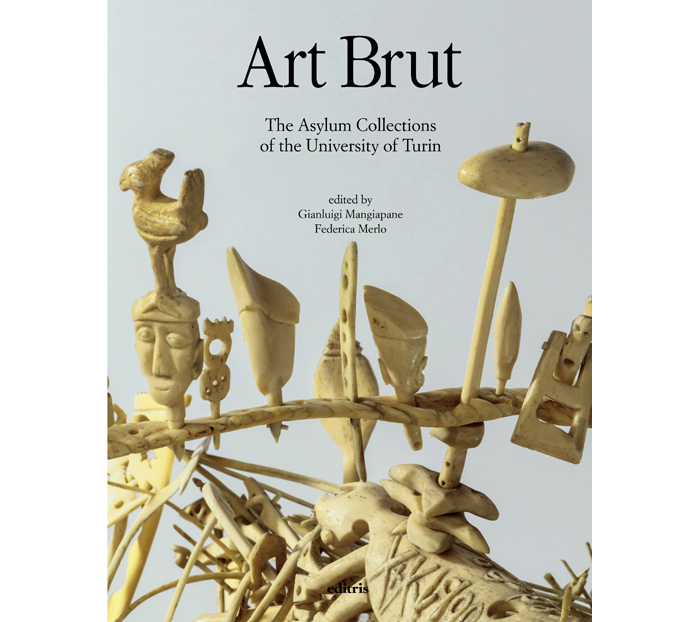
Art Brut
38,00€
The Asylum Collections of the University of Turin
A cura di: Gianluigi Mangiapane, Federica Merlo
Committenti: Museo di Antropologia criminale “Cesare Lombroso”, Museo di Antropologia ed Etnografia di Torino (UNITO)
176 pagine
formato 21×27 cm, dorso 13 mm
copertina morbida
lingua: inglese
© 2025 Editris Duemila snc, Torino
ISBN-9788889853924
Descrizione
Contents
Preface
Cecilia Pennacini, Silvano Montaldo
«A raccolta!»
Chiara Nenci
Art Brut at the University of Turin:
The Collection of Works from the Asylum Context at the Cesare Lombroso Museum of Criminal Anthropology
Federica Merlo
Art Brut at the University of Turin:
The Collection of Works from the Asylum Context at the Museum of Anthropology and Ethnography
Gianluigi Mangiapane
The TAZEBAO Project
Davide Borra
Telling the story of Art Brut through the Digital
Federico Citi, Riccardo Zanzi
Art Brut: Legal Profiles between Copyright, Privacy, and Cultural Heritage
Roberto Cavallo Perin, Francesca Paruzzo
Bibliography
Authors’ Biographies
“Those who believe that the intellectual power of the insane is diminished are gravely mistaken; on the contrary, it is often heightened in them, and in a singular manner.” Thus wrote Cesare Lombroso on 1 November 1863, in his inaugural lecture for his lectures in Anthropology and Clinical Psychiatry at the University of Pavia. The brief text, first published the following year under the title Genio e follia (Genius and Madness), was revised, expanded and reprinted five times, eventually reaching 743 pages in its final version of 1894, titled L’uomo di genio (The Man of Genius). While the original idea of the essay focused on cases of mental disturbance revealed in the biographies and works of famous artists, writers and scientists – in keeping with a theory in contemporary French psychiatry that genius had a neurotic or degenerative origin – by the second edition of Genio e follia, published in 1872, the space devoted to the creativity of psychiatric patients was already significantly expanded. Material meant to serve merely as a kind of counterproof to the main thesis now considered several cases of intellectual and artistic creation produced within asylums, which Lombroso had seen emerge from the hands of his patients in Pavia and later in Pesaro. For example, in the Pavian clinic he met a working-class woman who, convinced she was a descendant of Napoleon and persecuted by numerous enemies, displayed such talent for drawing and embroidery that she made “certain butterflies so light and so lifelike that they seemed to flutter there upon the fabric.” Another woman, “with a few lemon peels and eggshells modelled the most charming little vases and inkwells.” There was also the case of a cobbler – a murderer tormented by erotic-hallucinatory manias – whom madness had turned into a gifted writer.
In this way, the criminologist recounted the birth of a collection that would grow like the pages of his own books, enhanced by the marvellous works of his patients and by gifts sent by numerous admirers, including from abroad, to Turin, the city where he had moved to in 1876 to establish his controversial “science” of crime. This collection that was later expanded by Antonio Marro, Lombroso’s collaborator and a physician at the Turin psychiatric hospital, and by Marro’s son Giovanni, who made it one of the founding elements of the Museum of Anthropology and Ethnography of Turin (MAET).
In recent decades this cultural heritage has become the focal point for an interesting process of reinterpretation and appreciation within a broad debate concerning the very concept of art and the definition of “Art Brut,” a term coined by Jean Dubuffet in 1945.
Two separate collections, hitherto preserved in the Lombroso Museum and the MAET, have now been reunited virtually and rendered fully accessible to the public through a Digital Library of Art Brut in Turin, thereby giving back a space and voice to often-overlooked creative figures through a reconstruction of their biographies and the contexts in which they produced their creative works.



Recensioni
Ancora non ci sono recensioni.